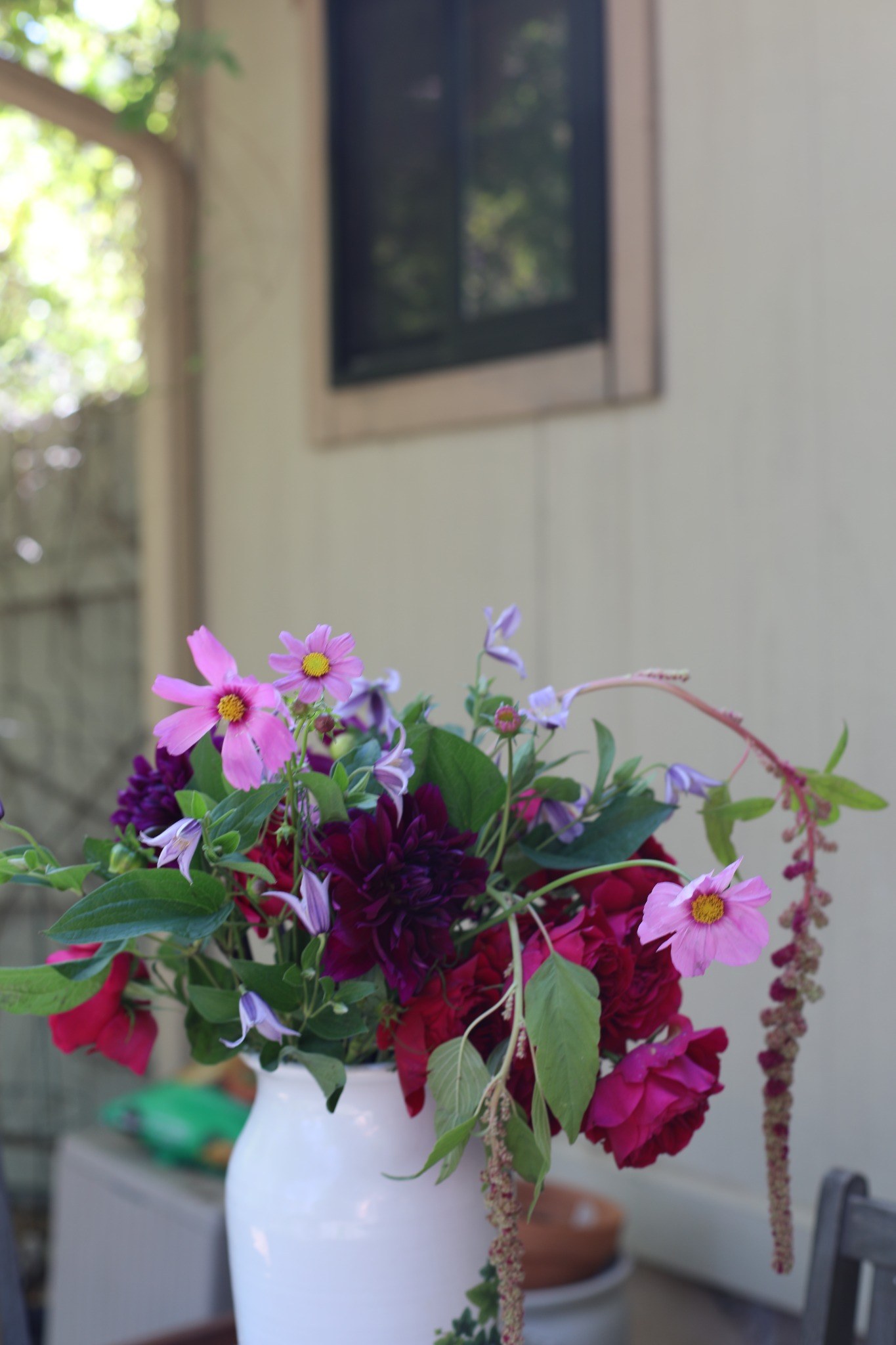
Start with the pieces you’ll see and enjoy most. At a smaller budget, we’d put flowers in a few deliberate places. As the budget grows, you can add wedding-party flowers, fuller tables, or more ceremony arrangements.
How to read this guide: These are example floral plans, not fixed packages or final quotes. Totals cover the listed floral designs and standard vessels. Delivery, setup, sales tax, and any additional services are separate. Bud-vase prices and sweetheart-table amounts below are planning allowances; your proposal confirms the flower mix, vessels, and final pricing.
How many stems are in a bridal bouquet?
A useful starting point is about 20–30 total stems for a mixed bridal bouquet, including flowers and greenery. A petite bouquet may use fewer; a generous garden-style design may use more. Stem count alone won’t tell you the size or price.
For context, Blooms By The Box’s quantity guide lists about 18–20 stems for a medium mixed bouquet and 25–30 for a large one. Its single-variety examples use fewer large garden roses than standard roses. FiftyFlowers gives a standard bouquet a starting range of 15–20 flowers, with the final count depending on design and greenery.
Premium flowers, standard flowers, and greenery.
Premium focal flowers might include garden roses, peonies, specialty ranunculus, or orchids, depending on variety and season. Standard flowers might include standard roses, carnations, and stock. Stock is also the name of a specific flower with several blooms along its stem. Greenery—such as ruscus, eucalyptus, or other foliage—creates shape and movement.
“Premium” describes the flower selection, not a guaranteed size. A large garden rose can fill more space than a small flower; an expensive delicate bloom may fill less. Spray flowers can carry several blooms on one stem. Greenery also varies in size and cost.
| What’s in it | Standard-flower mix | Premium-flower mix |
|---|---|---|
| Premium focal stems | 0 | 6 |
| Standard flower stems | 14 | 8 |
| Accent / texture stems | 4 | 4 |
| Greenery stems | 6 | 6 |
| Total stems | 24 | 24 |
Both recipes contain 18 flowering stems and 6 greenery stems. The premium mix can cost more even with the same stem count. We’d choose the actual recipe for the shape you love, how the flowers open, and what’s available for your date.
Sucker bridal bouquets are estimated at $175–$375. The lower end leaves more room for a petite design and a simpler seasonal mix; the upper end allows more scope for premium varieties or a fuller composition. Exact flowers and size are confirmed in your proposal.
Four ways to plan your wedding flowers.
The examples below show where we’d put the money. Table counts are explicit so you can compare them with your own floor plan. Boutonnières, corsages, candles, arches, and anything not listed would need a separate allowance.
The essentials, placed well.
For a smaller wedding where the bouquet, dinner tables, and ceremony entrance are the priorities.
| Selection | Quantity & rate | Subtotal |
|---|---|---|
| 1 bridal bouquet | 1 × $300 | $300 |
| 30 bud vases | 30 × $20 | $600 |
| 2 aisle meadows | 2 × $300 | $600 |
| Floral total | $1,500 | |
Place one meadow on each side at the back of the ceremony site. Divide the bud vases across your dinner tables: three per table for ten tables, or five per table for six. This plan doesn’t include wedding-party bouquets or large centerpieces.
The essentials, plus your people.
Keep the ceremony framing and add wedding-party flowers, more table detail, and a welcome arrangement.
| Selection | Quantity & rate | Subtotal |
|---|---|---|
| 1 bridal bouquet | 1 × $300 | $300 |
| 3 bridesmaid bouquets | 3 × $100 | $300 |
| 50 bud vases | 50 × $20 | $1,000 |
| 2 aisle meadows | 2 × $300 | $600 |
| 1 welcome arrangement | 1 × $300 | $300 |
| Floral total | $2,500 | |
Five bud vases on each of ten tables create a fuller scattering than the $1,500 example. Keep the larger flowers focused on the bouquet, welcome, and ceremony.
A centerpiece on every table.
For a reception with ten guest tables, give each table its own arrangement and keep a few strong ceremony moments.
| Selection | Quantity & rate | Subtotal |
|---|---|---|
| 1 bridal bouquet | 1 × $350 | $350 |
| 4 bridesmaid bouquets | 4 × $100 | $400 |
| 10 reception centerpieces | 10 × $300 | $3,000 |
| 2 aisle meadows | 2 × $300 | $600 |
| 1 welcome arrangement | 1 × $300 | $300 |
| Sweetheart-table flowers | Design allowance | $350 |
| Floral total | $5,000 | |
This is a change in table style, not simply more bud vases. Ten low centerpieces make the dinner setting the main floral investment. The sweetheart-table allowance can be adapted to the table’s size.
A fuller ceremony and reception.
For fifteen guest tables, a larger wedding party, and more flowers along the ceremony aisle.
| Selection | Quantity & rate | Subtotal |
|---|---|---|
| 1 bridal bouquet | 1 × $375 | $375 |
| 5 bridesmaid bouquets | 5 × $175 | $875 |
| 15 reception centerpieces | 15 × $400 | $6,000 |
| 6 aisle meadows | 6 × $300 | $1,800 |
| 1 bar arrangement | 1 × $500 | $500 |
| Sweetheart-table flowers | Design allowance | $450 |
| Floral total | $10,000 | |
Use two meadows to flank the back of the ceremony site and four farther along the aisle. This plan prioritizes fuller table arrangements and more ceremony flowers; a hanging installation or full floral arch would need its own scope.
What do the smaller pieces look like?
A bud vase is a small vessel with a few selected flowers—roughly 1–3 flowering stems as a starting design, with foliage where it suits the look. It creates a scattering of flowers rather than a solid centerpiece. The $20 example is an allowance for a simple seasonal design.
An aisle meadow is a low arrangement that feels like flowers growing up from the ground. The $300 examples use the estimator’s approximately one-foot-long design; two are accents, not a continuous floral aisle.
A reception centerpiece gives each table a fuller focal point. Sucker’s estimator runs $300–$500 per centerpiece. Table dimensions, flower choice, and desired fullness determine where your design lands.
How we’d adjust this for your wedding.
- More tables? Spread a bud-vase plan more lightly or reserve more of the budget for reception flowers.
- No wedding party? Move that money toward your bouquet, table flowers, or ceremony.
- A particular premium flower you love? Feature it in your bouquet and use a complementary mix elsewhere.
- Want to reuse ceremony flowers? We can discuss whether the pieces, timeline, and people available to move them make that practical. Moving and resetting flowers is not assumed in these totals.
Build your floral estimate.
Choose the pieces you need and see a running estimate. Share your palette, flower preferences, and inspiration with your inquiry, and we’ll work out the right mix for you.
Build your estimate →